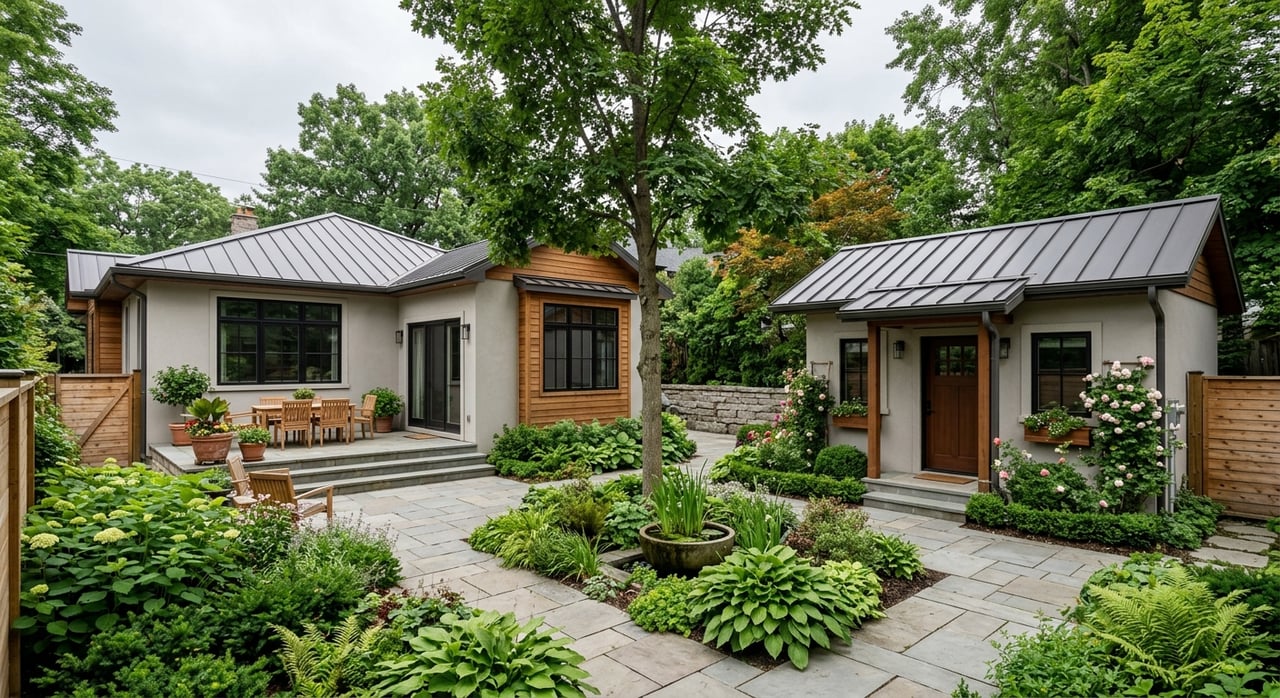
If you own a home in Santa Clara, your backyard may be doing less for your wealth than it could. An ADU, or accessory dwelling unit, can create rental income, support multigenerational living, and add flexibility to a property you already own. The key is understanding what Santa Clara allows, what it may cost, and how it fits into your long-term plan. Let’s dive in.
Why ADUs matter in Santa Clara
In a high-cost market like Santa Clara, an ADU can turn unused space or underused land into a working asset. Instead of buying another property, you may be able to create a second living space on your current lot and open up new income potential.
California’s Department of Housing and Community Development says ADUs can support rental income, aging in place, and extended-family living. Freddie Mac and Fannie Mae also note that ADUs may provide rental income and may increase long-term property value. For many homeowners, that combination makes an ADU less about short-term cash flow and more about long-term household stability.
Santa Clara’s rental market helps explain the appeal. Current apartment market trackers place average rents in Santa Clara around $3,300 to $3,500 per month, with studios and one-bedrooms averaging roughly $2,900 and $3,300. Those figures are not ADU-specific, but they show why even a smaller unit can have a meaningful impact on your finances.
How ADUs build long-term wealth
Rental income can improve cash flow
One of the clearest benefits of an ADU is the chance to add recurring income. That income may help offset your mortgage, support other household expenses, or create more breathing room in your monthly budget.
Over time, that matters. A steady rental stream can make your property more resilient during market shifts, job changes, or major life events. If you are thinking about wealth-building in practical terms, stronger cash flow is a solid place to start.
Flexibility adds value over time
An ADU is not only for tenants. It can also serve as space for family, caregivers, adult children, or guests, depending on your needs and local rules.
That flexibility can be valuable at different stages of life. You may use the unit one way today and another way years from now, which can make your property more adaptable without requiring a move.
You are improving land you already own
Buying another property in Silicon Valley is not easy. ADUs offer a different path by letting you create more utility from land you already control.
That matters because the biggest wealth-building advantage may come from adding function to an existing asset. You are not starting from zero. You are building on a foundation you already have.
Santa Clara ADU rules to know
Santa Clara has local rules that shape what is feasible, and many projects can move through the process with a building permit. According to the city, a main exception is a new attached second-story ADU on a single-story residence, which requires architectural review.
For many homeowners, that is encouraging because it can simplify the approval path. Even so, site conditions and design details still matter, so it helps to understand the framework early.
Size limits in Santa Clara
For detached ADUs, Santa Clara allows up to 1,000 square feet on parcels of 5,500 square feet or less. On larger parcels, detached ADUs may be up to 1,200 square feet.
Attached ADUs are capped at 1,000 square feet or 50 percent of the primary home’s size, whichever is less. State law also provides a minimum allowance of 800 square feet in many cases. Converted ADUs created from existing space or accessory structures do not have the same maximum size limit.
JADUs, or junior accessory dwelling units, are limited to 500 square feet. They must be located within a single-family home and cannot be placed in accessory structures.
Setbacks, height, and separation
Santa Clara’s handout says detached ADUs generally need 4-foot rear, side, and corner setbacks. The city also requires 6 feet of separation from the main residence.
Height limits are also important. A single-story detached ADU may be up to 18 feet tall, while a 1.5-story version may be up to 25 feet.
Parking rules are more flexible
Santa Clara does not require parking for an ADU or JADU. The city also does not require replacement parking if you convert or remove a garage, carport, or covered parking space as part of the project.
That can make some properties much more viable than owners expect. Lots that seem tight on parking may still work for an ADU under current rules.
Site constraints still matter
Not every lot is simple. Santa Clara says ADUs cannot be placed in easements or sight-distance triangles, and historically designated properties may require additional review.
The city also notes that newly constructed detached ADUs require solar panels under the reach code. That is an important budget item to factor in from the beginning, not as a last-minute surprise.
What an ADU may cost in Santa Clara County
Cost is often the biggest question, and the answer depends heavily on the type of project. Santa Clara County ADU resources suggest using $400 to $550 per square foot as a rough planning range that includes construction, design, and fees.
That wide range exists for a reason. A simple interior-conversion JADU may start around $30,000, while a large detached ADU with high-end finishes on a difficult site can exceed $400,000.
Timing also matters. Most ADU projects take 12 to 18 months, and some take 24 months or more. If you are evaluating an ADU as an investment, your timeline should include planning, approvals, construction, and lease-up.
Ways to improve the numbers
Start with a realistic budget
Strong ADU decisions begin with honest math. Before you focus on possible rent, it helps to understand your likely design, permit, and construction costs, plus solar and any site-related challenges.
Santa Clara County offers an ADU Calculator designed to estimate project cost, potential rent, and return on investment using local data. For planning purposes, that is a more relevant tool than general apartment averages alone.
Consider pre-approved plans
Santa Clara participates in the county ADU program and offers pre-approved plans. The city says eligible and complete site-specific submittals under that program can be reviewed in 10 business days, with five business days for later rounds.
The city also says there is no additional plan review fee for projects submitted under its pre-approved ADU plan program. That may not remove all complexity, but it can help reduce friction in the early stages.
Match the ADU type to your goal
Not every ADU has the same purpose. If your main goal is lower upfront cost, a conversion or JADU may make more sense than building a detached unit from scratch.
If your goal is stronger long-term rental income or more privacy, a detached ADU may be worth the higher budget. The right answer depends on your lot, your timeline, and how you plan to use the space.
Financing options to explore
Many homeowners assume ADUs must be paid for entirely with cash, but county resources say people often mix savings, family loans, home equity, and lender financing. That opens more options than many buyers and owners expect.
Fannie Mae says borrowers may use HomeStyle Renovation to add an ADU and Construction-to-Permanent financing to build a home with an ADU. It also says HomeReady may allow buyers or owners to qualify while counting rental income from an existing ADU.
Freddie Mac says ADUs can be financed through its mortgage offerings and that ADU rent may help with qualification. HUD also says FHA’s 203(k) program may finance a purchase or refinance plus eligible renovation, including building an ADU.
Tax points homeowners should plan for
ADUs can support wealth, but they also come with tax considerations. IRS Publication 527 says residential rental income is generally taxable, and rental expenses are generally deductible.
The same publication says depreciation usually begins when the property is ready and available for rent. If you convert personal-use space to rental use, the depreciation basis is generally the lesser of adjusted basis or fair market value on the conversion date.
Local property taxes matter too. The Santa Clara County Assessor says new construction is reappraised at current market value when completed and may trigger a supplemental assessment for the added improvements.
Under Proposition 13, annual assessment increases are generally capped at 2 percent, and the basic property tax rate is limited to 1 percent of assessed value plus voter-approved additions. Still, new construction creates a new base-year value for the added improvements, so it is smart to budget for that impact.
A smart ADU strategy starts before construction
The best ADU decisions usually happen well before plans are submitted. You want to understand what your lot can support, what your likely budget range looks like, how long the project may take, and whether the finished unit fits your broader goals.
For some owners, an ADU is mainly about rental income. For others, it is about housing family now while preserving future flexibility. In either case, the strongest outcome usually comes from treating the project as part of your larger real estate and wealth strategy, not as a stand-alone build.
If you are weighing whether an ADU makes sense for your Santa Clara property, the right guidance can help you look at resale, rental potential, carrying costs, and long-term use in one clear picture. The Heather Lin Real Estate Team can help you think through your options with a local, education-first approach.
FAQs
What is an ADU in Santa Clara?
- An ADU is an accessory dwelling unit, which is a secondary living space on the same lot as a primary home. In Santa Clara, it may be detached, attached, or created through conversion of existing space.
What is a JADU in Santa Clara?
- A JADU, or junior accessory dwelling unit, is a smaller unit of up to 500 square feet that must be located inside a single-family home and cannot be built in an accessory structure.
How big can a detached ADU be in Santa Clara?
- Santa Clara allows detached ADUs up to 1,000 square feet on parcels of 5,500 square feet or less, and up to 1,200 square feet on larger parcels.
Does Santa Clara require parking for an ADU?
- No. Santa Clara says it does not require parking for an ADU or JADU, and it does not require replacement parking if covered parking is converted or removed for the project.
How much does an ADU cost in Santa Clara County?
- County resources suggest using about $400 to $550 per square foot as a rough planning range, though actual cost depends on the project type, finishes, and site conditions.
How long does an ADU project take in Santa Clara County?
- Most ADU projects take about 12 to 18 months, though some can take 24 months or more depending on complexity.
Are ADU rental income and expenses taxable in California?
- ADU rental income is generally taxable, and rental expenses are generally deductible. Depreciation rules may also apply once the unit is ready and available for rent.
Will building an ADU affect Santa Clara County property taxes?
- It can. The county Assessor says new construction is reappraised when completed and may trigger a supplemental assessment for the added improvements.